
What Are the Most Secure Employee ID Badge Features?
19th Jun 2026
Employee ID badges are no longer just simple cards with a photo and employee name. Today’s organizations rely on secure ID badges to help prevent unauthorized access, reduce the risk of counterfeit credentials, and strengthen workplace safety. Whether you manage a corporate office, healthcare facility, school campus, government building, or manufacturing plant, having the right badge security features can make a major difference in protecting people and property. Modern ID badges commonly combine visual verification, access control technology, and anti-counterfeit features to improve workplace security.
In this guide, we’ll cover the most secure employee ID badge features and why organizations are increasingly investing in layered credential security.
1. High-Quality Employee Photos
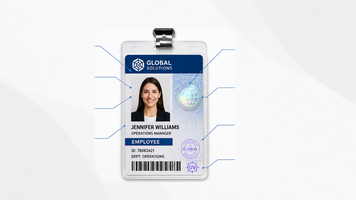
One of the most basic but important badge security features is a clear, professional employee photo. A high-resolution image makes it easier for security personnel, managers, and coworkers to quickly identify employees and spot unauthorized individuals.
Blurry, outdated, or inconsistent photos can weaken badge effectiveness and create opportunities for impersonation. Organizations should standardize badge photos with consistent lighting, backgrounds, and image quality.
Best practices include:
- Front-facing photos
- Neutral backgrounds
- Updated employee images
- Consistent cropping and formatting
2. Access Control Technology (RFID, Smart Cards, or Proximity Credentials)
A secure employee badge should do more than display identity — it should verify authorization. Many organizations integrate employee badges with access control systems using technologies such as:
- Proximity cards
- RFID credentials
- Smart cards
- NFC-enabled credentials
- Mobile credential integration
These technologies allow employees to securely tap or scan their badge to gain access to approved areas while restricting unauthorized movement throughout a facility. Encoded credentials tied to an access control system provide stronger protection than visual-only badges.
For organizations managing sensitive areas, role-based access permissions can ensure employees only access locations necessary for their job function.
3. Holographic Overlays and Laminates
Holographic overlays are one of the most effective anti-counterfeit badge features available. These overlays create visual elements that are difficult to duplicate using standard printers or copying equipment.
A holographic laminate not only makes badges more secure but also protects the card surface from daily wear and tear. Organizations commonly customize holograms with company logos or unique designs to make replication even more difficult.
Benefits of holographic badge overlays:
- Helps deter counterfeiting
- Makes visual authentication easier
- Increases badge durability
- Protects printed card information
4. UV Printing (Invisible Security Features)
UV printing adds a hidden layer of protection to employee ID badges. With ultraviolet ink, logos, text, or symbols remain invisible under normal lighting but appear under a UV light source.
Because UV security features are difficult to reproduce, they provide an added verification method for security teams and reception staff. Organizations often use UV printing for hidden logos, authentication marks, or employee validation identifiers.
5. Color-Coding for Access Levels
Color-coded employee badges can improve visual security by making it easier to identify staff roles and authorization levels at a glance.
For example:
- Employees may have one badge color
- Contractors another
- Visitors a clearly distinct design
This visual distinction helps reduce confusion and makes unauthorized individuals easier to spot. However, color coding only works when consistently enforced and supported by employee training.
6. Microtext and Watermarks
Microtext and watermarks add covert security elements that are difficult for counterfeiters to replicate.
Microtext uses tiny lettering that can only be viewed under magnification, while watermarks create embedded patterns or designs inside the badge layout. These features are especially useful in high-security industries such as healthcare, education, government, and critical infrastructure.
7. Tamper-Evident Badge Features
Tamper-evident badge materials help organizations identify when someone has attempted to alter or manipulate an ID card.
Some credentials permanently display visual damage or a “VOID” pattern if someone tries to peel apart badge layers or remove security films. This can help prevent badge sharing, fraud, and unauthorized modifications.
8. Expiration Dates for Temporary Staff and Contractors
Temporary workers, vendors, interns, and contractors should not receive permanent credentials.
Adding expiration dates to badges ensures credentials are only valid for a designated timeframe. Many organizations also pair printed expiration dates with automatic access deactivation inside the access control system.
9. Secure Badge Printing Technology
The printer used to create employee badges can also impact security.
Retransfer ID card printers are commonly used when organizations need edge-to-edge print quality, enhanced durability, and tamper resistance. Some high-security badge programs also incorporate lamination modules for additional protection and holographic overlays. Retransfer printing can make badge manipulation more difficult because attempts to alter the printed surface often damage the credential itself.
Why Layered Badge Security Matters
The most secure employee ID badges combine multiple security features rather than relying on a single protection method. A badge with a clear photo, RFID credential, holographic overlay, UV printing, and role-based access permissions is significantly harder to counterfeit or misuse than a standard printed card. Security professionals increasingly recommend layered credential strategies that combine physical identification with digital authentication methods.
Strengthen Your Employee ID Badge Security
Employee ID badges play a critical role in protecting your organization, but true security goes beyond appearance. Implementing the right features can help prevent unauthorized access, reduce credential fraud, and improve overall workplace safety.
When evaluating secure ID badge solutions, it’s important to consider technologies and features that enhance protection and reliability, such as advanced encoding options, holographic overlays, UV printing, tamper-resistant materials, and credential lifecycle controls.
Whether you're upgrading an existing badge program or building a new one, the right approach can significantly improve both security and operational efficiency.
Contact us today to speak with an ID credential specialist and explore secure ID badge solutions designed to protect your organization and strengthen your access control strategy.