
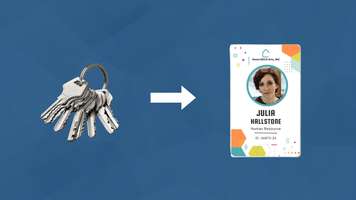
How to Upgrade From Traditional Keys to Secure Badges
11th Aug 2026
Traditional keys have been used for decades to secure businesses, schools, healthcare facilities, and other organizations. While keys are simple and familiar, they also come with significant security challenges. Lost keys, unauthorized duplicates, and difficulty tracking who has access to specific areas can create vulnerabilities.
Many organizations are upgrading from traditional keys to secure badge-based access control systems. By using employee ID badges, smart cards, proximity cards, or mobile credentials, businesses can improve security, simplify access management, and gain better control over who enters their facilities.
The Limitations of Traditional Keys
Traditional keys provide a basic level of security, but they lack the flexibility and visibility that modern organizations need.
Common challenges with traditional keys include:
- Lost or stolen keys create security risks – If a key is misplaced, organizations may need to rekey locks or replace hardware to prevent unauthorized access.
- No access history – Traditional locks cannot record who entered a building or restricted area.
- Difficult access management – Managing hundreds of physical keys across employees, contractors, and visitors can become complicated.
- Unauthorized duplication – Keys can potentially be copied without an organization’s knowledge.
- Time-consuming employee changes – When employees leave, collecting and disabling keys can be difficult.
Secure badge systems address many of these challenges by allowing organizations to electronically manage access permissions.
What Are Secure Access Badges?
Secure access badges are identification credentials that allow authorized users to enter controlled areas through an electronic access control system. These badges often combine employee identification information with embedded technology that communicates with card readers.
Common secure badge technologies include:
- Proximity cards – Contactless credentials that allow users to gain access by presenting the card near a reader.
- Smart cards – Credentials with embedded chips that provide enhanced security and data storage capabilities.
- Contactless RFID cards – Wireless credentials commonly used for modern access control systems.
- Mobile credentials – Smartphone-based access solutions that allow users to unlock doors digitally.
Many organizations combine access credentials with printed photo ID badges for an added layer of security.
Benefits of Switching to Badge-Based Access Control
Improved Security
Secure badges allow organizations to control exactly who has access to specific areas. If a badge is lost or an employee leaves the company, access can be quickly disabled without changing physical locks.
Better Access Management
Electronic access control systems allow administrators to assign permissions based on:
- Employee role
- Department
- Location
- Work schedule
- Security level
This makes it easier to manage access across multiple buildings or restricted areas.
Real-Time Monitoring
Unlike traditional keys, many access control systems can track entry activity. Organizations can review access events to better understand facility usage and support security investigations.
Faster Employee Onboarding and Offboarding
New employees can receive access badges quickly, while departing employees can have their credentials immediately deactivated.
Reduced Long-Term Costs
Although upgrading requires an initial investment, badge-based systems can reduce expenses related to replacing lost keys, changing locks, and manually managing access.
Steps to Upgrade From Keys to Secure Badges
1. Evaluate Your Current Security Needs
Before replacing traditional keys, identify:
- Which areas require controlled access
- Who needs access
- Current security concerns
- Number of employees or users requiring credentials
- Future expansion plans
This assessment helps determine the right access control solution.
2. Choose the Right Credential Technology
Different organizations require different levels of security. Common options include:
- Proximity Cards: A cost-effective option for organizations that need simple, contactless access.
- Smart Cards: A more secure option that supports advanced authentication and additional applications.
- Mobile Credentials: A convenient solution that allows users to access facilities using smartphones.
- Multi-Technology Credentials: Cards that support multiple access technologies for organizations transitioning from older systems.
A badge-based system typically includes:
- Electronic door readers
- Access control panels
- Management software
- Credentials such as badges or cards
- Optional integration with security systems
The hardware allows doors to communicate with the credential and determine whether access should be granted.
4. Set Up an ID Badge Printing System
Many organizations choose to print access badges in-house using an ID card printer. This allows them to create professional employee credentials with:
- Employee photos
- Names and job titles
- Company branding
- Barcodes or QR codes
- Access control technology
An in-house badge printing system makes it easier to issue, update, and replace credentials.
5. Train Employees on the New System
Employees should understand:
- How to use their badges
- What to do if a badge is lost
- Security policies for sharing credentials
- Proper badge display requirements
A successful transition requires both technology and employee awareness.
Can Existing ID Badges Be Used for Access Control?
In many cases, yes. Organizations may be able to combine employee identification cards with access control credentials by using compatible smart cards, proximity cards, or RFID-enabled badges.
However, compatibility depends on:
- Existing access control system
- Card technology
- Reader type
- Encoding requirements
- Badge printer capabilities
Before upgrading, organizations should verify that new credentials will work with their current security infrastructure.
Industries Moving From Keys to Secure Badges
Badge-based access control is commonly used in:
- Corporate offices
- Healthcare facilities
- Schools and universities
- Government facilities
- Manufacturing plants
- Financial institutions
- Research facilities
- Data centers
Organizations in these industries often require stronger security, better access tracking, and easier credential management.
Contact us today
Upgrading from traditional keys to secure badges provides organizations with greater control, improved security, and a more efficient way to manage facility access. Electronic credentials make it easier to add users, remove access, monitor activity, and protect sensitive areas.
By combining an access control system with an ID card printer and secure credential technology, organizations can create a complete identification solution that improves both security and convenience.
ProxCards can help you implement a complete access control and ID badging solution tailored to your organization's needs. Contact us today to learn how secure credentials, ID card printers, and access control systems can work together to protect your people, property, and operations. While ProxCards do not install access control systems, we can connect with you a local access control partner.